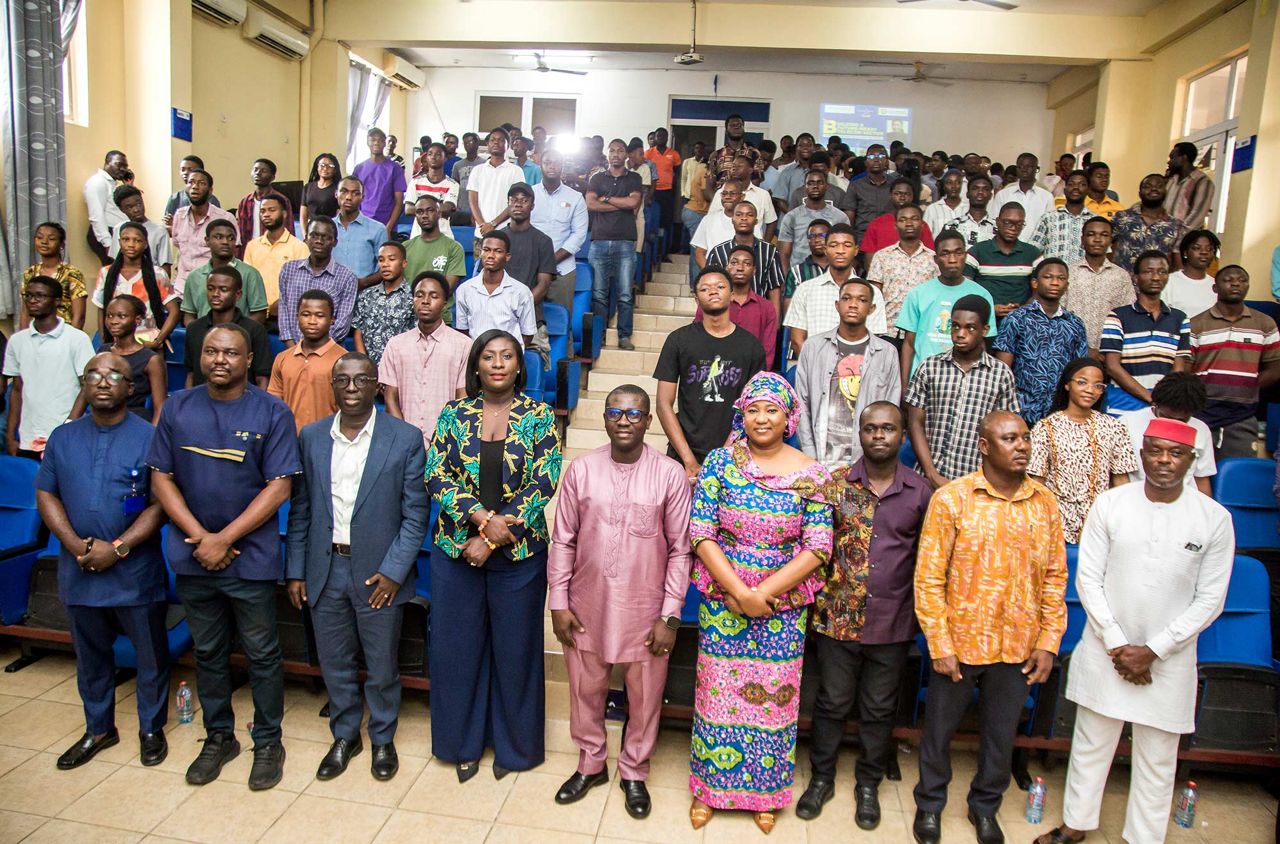


The GCTU Faculty of Engineering and the Industrial Liaison Department, in collaboration with the Ghana Chamber of Telecommunications, have hosted the 26th Annual Knowledge Forum on December 17, 2025, at the Florence Onny Auditorium.
The event, held under the theme “Building a Future-Ready Telecom Sector: Navigating Ghana’s New Digital Policy Framework,” brought together representatives from government, regulators, network operators and other sector players. It aimed at discussing key trends in the mobile industry and their relevance to the Ghanaian market.

Speaking at the event, the Dean of the Faculty of Engineering, Dr. Ruhiya Abubakar, warmly welcomed participants. “Today, we are gathered for a forward-thinking moment to explore a crucial subject for our collective growth,” she said. Dr. Abubakar added that the event provides a platform for sharing insights, fostering collaboration and sparking innovation. She emphasized that telecommunications are essential to powering digital transformation by enabling AI integration, IoT and 5G/6G connectivity. These technologies drive economic growth, support remote connectivity through satellites, and deliver hyper-personalized customer experiences, while serving as the backbone for smart cities, autonomous systems, and global business operations.
Dr. Abubakar also underscored the importance of a robust digital policy framework, noting that it helps regulate the industry, encourage investment and innovation, ensure universal access and protect consumers.

Giving her remarks, the Chief Executive Officer of the Ghana Chamber of Telecommunications and Convener, Mrs. Sylvia Owusu-Ankomah, expressed her profound gratitude to GCTU for hosting the event. “We are deeply grateful to GCTU for hosting us and for your continued commitment to bridging academia and industry, which is an essential link in Ghana’s ICT transformation journey,” she remarked.
Mrs. Owusu-Ankomah emphasized that over the past two decades, the telecommunications sector has become the backbone of Ghana’s economy – enabling financial inclusion through mobile money and powering the education, healthcare and entertainment sectors. She added that the sector supports public service delivery, facilitates trade and connects citizens to opportunities beyond Ghana’s borders.
According to her, the telecommunications industry is capital-intensive and critical to Ghana’s development, stressing that sustainable digital progress requires strong collaboration among stakeholders. She further noted that policy reforms are needed to modernize Ghana’s digital governance framework, with a focus on trust, infrastructure resilience, data privacy and security.
“Policy decisions will impact investment, affordability and innovation over the next five to ten years. The Chamber’s role is constructive, providing practical insights to help shape Ghana’s digital policy framework,” Mrs. Owusu-Ankomah stated.
She highlighted five key principles essential for building a future-ready telecommunications sector:
- Regulatory clarity and institutional alignment
- Proportionate, predictable and sustainable cost structures
- Investment-friendly and technology-neutral frameworks
- Balanced governance, effective enforcement and regulatory independence
- Inclusive growth through collaboration and market-led solutions

In an address delivered on behalf of the Director-General of the National Communications Authority (NCA), Rev. Ing. Edmund Yirenkyi Fianko, the Acting Head of the Regulatory Administration Division, Mr. Kofi Ntim Yeboah-Kordieh, stated that the telecommunications sector is the backbone of Ghana’s digital economy, driving competition and innovation. He noted that rapid technological shifts such as mobile broadband expansion, smartphones, fintech, and e-commerce, require updated regulatory frameworks.
He explained that the current NCA laws – the NCA Act, 2008 (Act 769) and the Electronic Communications Act, 2008 (Act 775) – are outdated and do not adequately address emerging complexities, including data governance, cybersecurity and digital inclusion.
“Today, we face new realities: data governance and cybersecurity are now central to national security. Digital inclusion requires policies that ensure equitable access and meaningful connectivity for rural and underserved communities. Spectrum management must adapt to the demands of 5G and beyond. Competition and innovation require frameworks that encourage investment while protecting consumers,” he elaborated.
According to him, addressing these challenges makes it imperative to review and update the existing laws and Acts. He added that this process is not merely a legal exercise but a forward-looking effort aimed at anticipating and supporting the next wave of Ghana’s digital transformation.
The Director of CUTS International West Africa Centre, Mr. Appiah Kusi Adomako, delivered a presentation titled “Overview of the Emerging Communications Bills.” He noted that imposing laws and regulations without conducting a regulatory impact assessment could lead to unintended consequences and impose additional costs on businesses, which may ultimately be passed on to consumers. He emphasized that the ongoing reforms require careful scrutiny, adequate stakeholder consultation and restraint from passing laws under a Certificate of Urgency.
Mr. Adomako further observed that while market conduct and competition provisions introduce explicit competition obligations, they are not sufficiently robust. He stressed that CUTS International has submitted a comprehensive proposal aimed at deepening competition in the telecommunications sector. According to him, legal reforms are necessary to align the industry with emerging trends and international best practices.

During the panel discussion session, experts from diverse backgrounds shared their insights and experiences, offering valuable perspectives on Ghana’s emerging digital policy framework. They identified areas where continued dialogue and refinement are needed to strengthen policy outcomes, while also sharing viewpoints from industry, regulatory and academic perspectives.